

Silhouette: The Secret Language of Dress Design
If fabric is the voice of a dress and color is its expression, then silhouette is its skeleton — the underlying shape that determines how a dress moves, fits, and communicates before a single detail is even noticed. Silhouette is arguably the most important word in fashion design, because it’s the first thing the eye perceives and the last thing the memory forgets.
What Exactly Is a Silhouette?
In fashion, silhouette refers to the overall outline or shape a garment creates on the body — essentially, what you’d see if the dress were reduced to a solid black shadow. Before color, print, or embellishment register, silhouette is what the brain processes first. A designer can change fabric, trim, and detailing endlessly, but the silhouette is the foundational decision that shapes everything else.
The Classic Silhouettes That Defined Eras
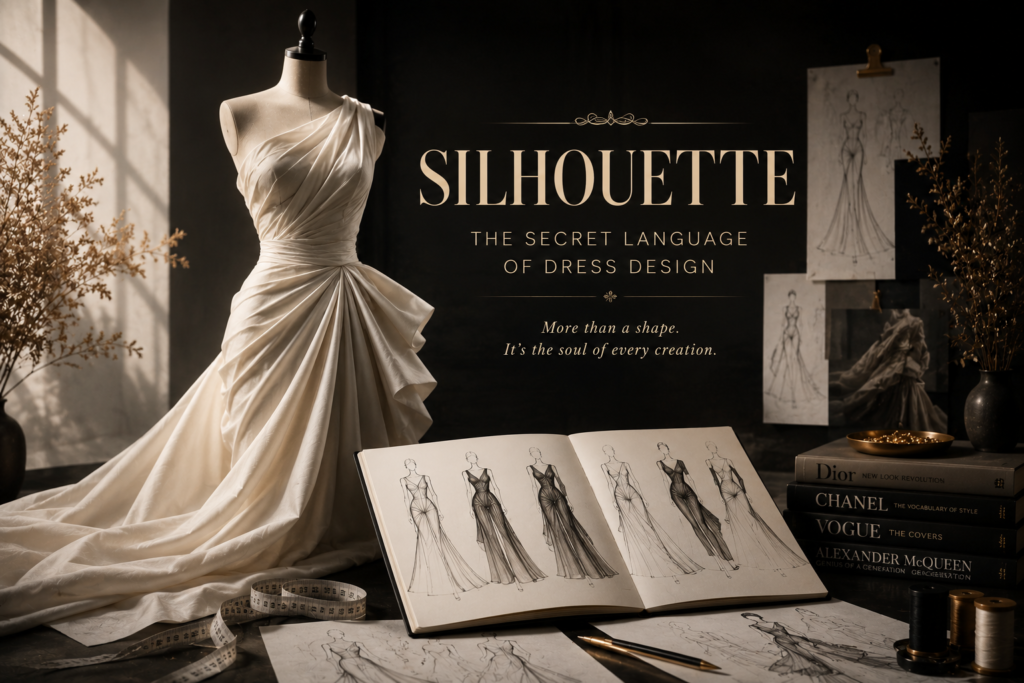
Fashion history can almost be read as a history of changing silhouettes:
- The Hourglass (1950s): Cinched waist, full bust and hips — popularized by Christian Dior’s “New Look,” this silhouette celebrated exaggerated femininity after wartime austerity.
- The Sheath (1960s): Straight, body-skimming, and minimal — a rebellion against structure, epitomized by Jackie Kennedy’s elegant simplicity.
- The Empire Silhouette: A raised waistline just under the bust, flowing loosely from there — first popular in the early 1800s, later revived for its flattering, romantic drape.
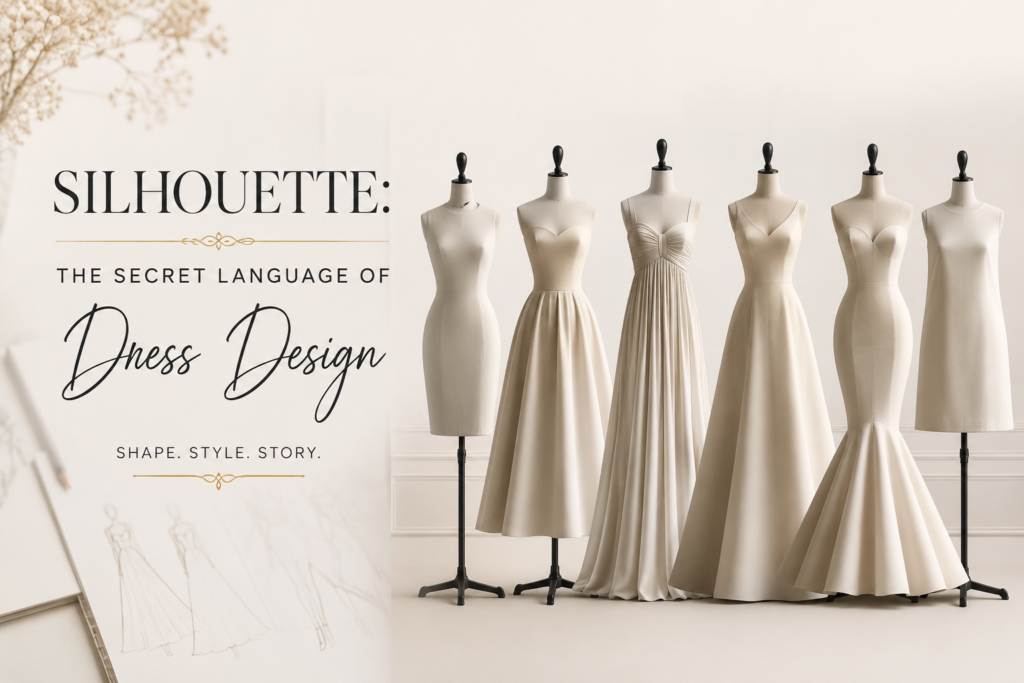
- The A-Line: Fitted through the bodice and gently flaring outward like the letter “A” — one of the most universally flattering shapes, still a go-to today.
- The Trumpet or Mermaid: Fitted through the body and flaring dramatically at the knee — a dramatic, glamorous silhouette favored for eveningwear and bridal gowns.
- The Shift: Straight-cut with minimal shaping — a symbol of 1960s modernism and effortless cool.
Why Silhouette Matters More Than Trend
Trends in color, print, and fabric come and go quickly, but silhouettes tend to cycle back over decades because they relate to something more permanent: how a shape makes a body feel. A well-chosen silhouette can:
- Flatter proportions by balancing shoulders, waist, and hips
- Convey mood — sharp and structured silhouettes feel powerful, while soft and flowing ones feel romantic or relaxed
- Signal occasion — a fitted sheath says “boardroom,” while a billowing maxi says “garden party”
- Transcend body type — unlike specific measurements, silhouette can be adapted to fit and flatter a wide range of body shapes
Finding Your Silhouette
Understanding your own preferred silhouette is often more useful than chasing trends. A few starting points:
- Study your comfort zone. Do you gravitate toward fitted or flowy clothing? This often points to a silhouette family you already love.
- Consider proportion balance. If a dress is fitted on top, a fuller skirt often creates balance — and vice versa.
- Think about movement. Silhouettes like the A-line or maxi allow ease of motion, while sheaths and mermaids are more sculptural and structured.
- Experiment across occasions. The same silhouette family (say, empire waist) can appear in a casual sundress or a formal gown — try both to see how it suits your lifestyle.
The Future of Silhouette
Modern fashion is increasingly playing with deconstructed and asymmetric silhouettes — shapes that defy the classic symmetry of the past. Designers are blending elements from multiple eras, creating hybrid forms that feel both nostalgic and new. Sustainability is also shaping silhouette trends, as designers explore shapes that require less fabric waste or that suit versatile, multi-use garments.
Conclusion
Silhouette is the quiet architecture behind every dress — often overlooked, yet endlessly influential. It’s the difference between a dress that simply covers the body and one that transforms it. Understanding silhouette isn’t just useful for designers; it’s a powerful tool for anyone who wants to dress with intention, choosing shapes that don’t just follow trends, but truly reflect who they are.